The Exhibition

I spent some days out on the streets of Stockholm this fall, photographing people and asking them questions. It turned into an exhibition. Me and my friend hung our art in a bookstore in the city, run by people we know. I never really wrote about it here, so well. Now I am.

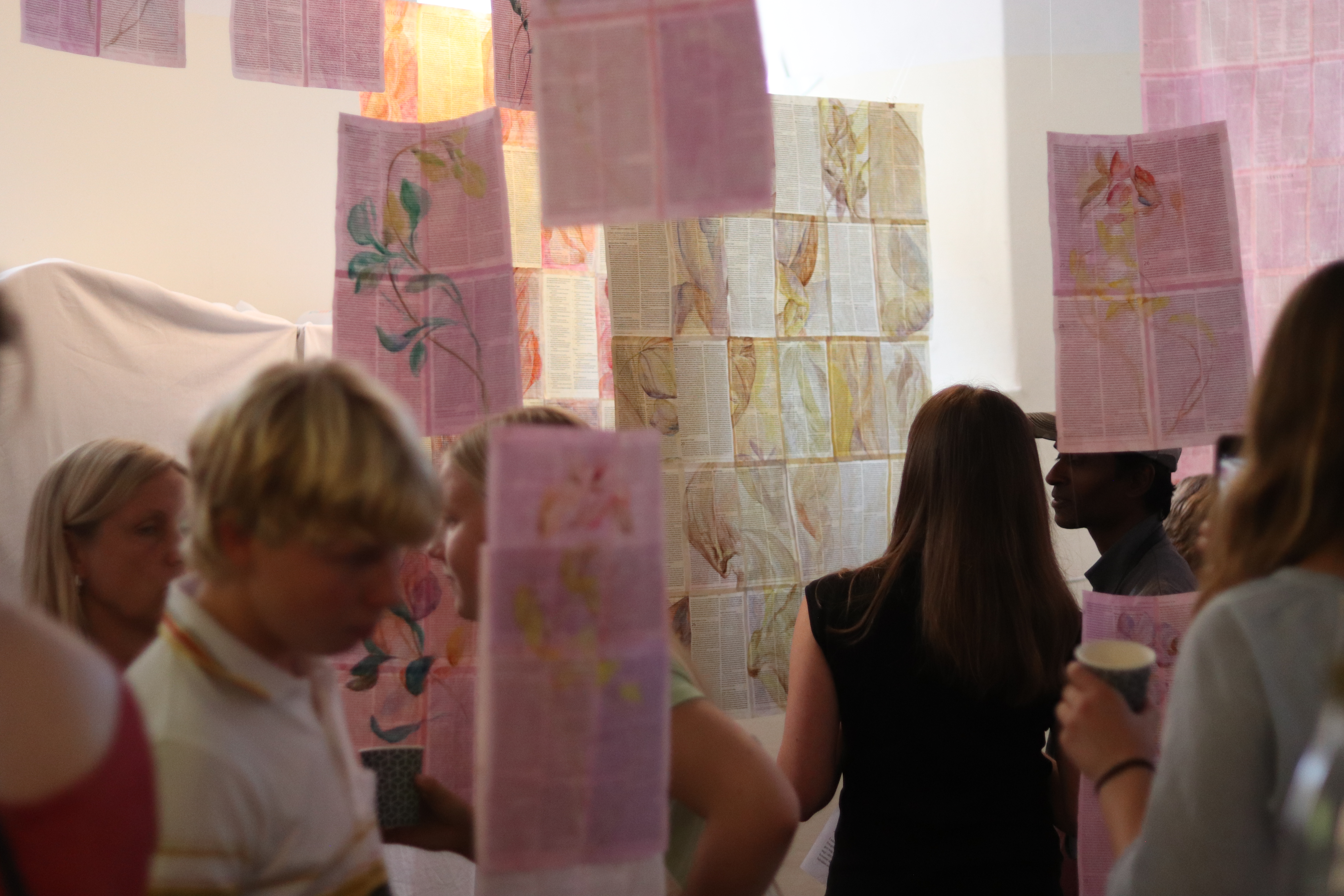
When I say that it turned into an exhibition, it’s not quite true. We had an exhibition date set quite early, and I had no art. I had to make something. And I didn’t want to bring a random collection of my paintings, without any coherent theme. So I made something in response to the art my friend was going to show.

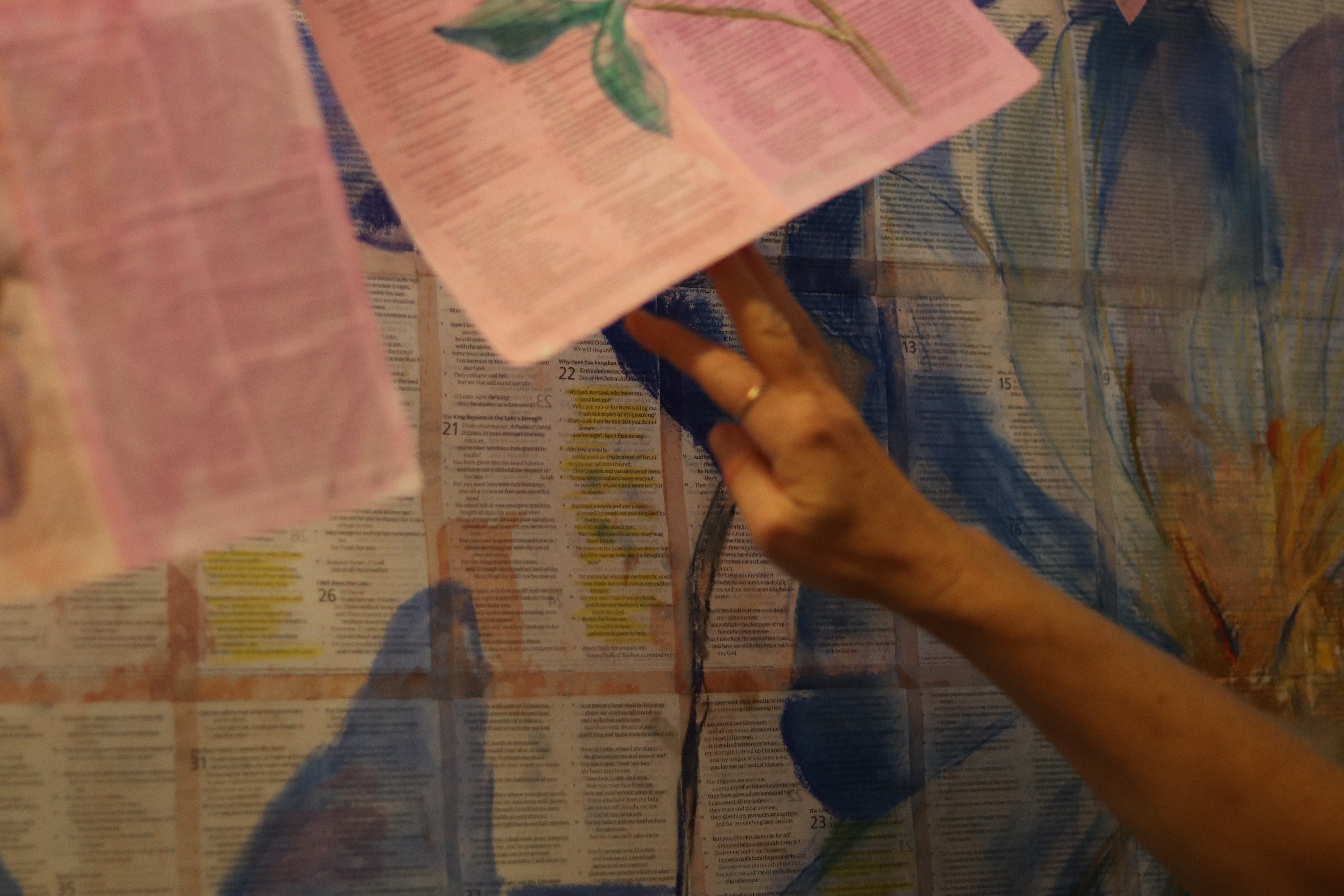
She’d been painting florals on taped together bible pages. On the theme of what’s brittle, and what’s eternal. Inspired by the book of Isaiah:
“A voice says, “Cry out.”
And I said, “What shall I cry?”
“All people are like grass,
and all their faithfulness is like the flowers of the field..”

It’s about what’s futile, but also about what’s important. So I thought, what words matter? Out of all the things we say, what lasts? I photographed people on the street and asked them:

“What’s the most important thing you’ve ever said?”

Here are a couple of answers.


I love you. When I say it to my wife and my kids. It’s not so often that I say it. I’m trying to think when was the first time… probably when she was my wife to be. When I knew that it was her. With the kids it’s different, I probably haven’t said it as often.”

The more he talked, the more he seemed to get into a bit of a crisis about whether he actually had said I love you to his kids. It was a bit funny. Maybe he went home and told them. He was great to talk to, and so good to photograph, look at that side profile.


Get lost.”

This woman knew exactly what she was going to answer. Usually people are a bit overwhelmed, the most important thing you’ve ever said, it’s a big question. But not this woman. She was nodding and had an answer ready before I even finished talking. “Get lost. That’s the most important thing,” she said.
I asked something more about it, what made her say it. She said that it was to someone who made her life miserable. That it was survival instinct. She spoke about it very bluntly, in short, confident sentences. There’s something in her posture too, I think. You can see that she knew her answer. Back straight.


I wrote everyone’s answer on the back of their portraits, and hung them in the middle of the room, so that people could walk around and read.

(And now you’ve seen some of it, so you’ve basically been to our exhibition, virtually, yey!)

The most important thing I’ve learned

You have to stop being disappointed in yourself.

I’m not talking about the conscious effort to deny the specific feeling. No, you have to stop actually disappointing yourself. And it’s not as difficult as you might think.

If you constantly try to clean more but never do, I’m not talking about stopping the disappointment you feel about your inability to do so. If you always say you’re gonna work out more but never actually follow through, I don’t care much about having more grace for yourself, although that might also be a thing.

What I’m talking about is to stop expecting certain things from yourself.

That might seem like a gloomy outlook to have for the rest of your life. But here’s the thing: I don’t know how many times I’ve thought “tomorrow I’m gonna get up early and be productive” and then failed to do so. Probably a hundred times. Several hundred. And that might seem stupid. It makes me feel stupid, that’s for sure. But what’s actually stupid is not that I’m constantly failing, but the fact that I keep thinking I’ll succeed.

Why do I do that to myself? When I know what works for me, why do I keep expecting myself to tomorrow be able to get up early and be super productive and happy and full of magical will power? Extending grace is good, truly, it’s unnecessary to feel shame over your inability. But if you want to take it one step further, you can also stop putting yourself in situations where you constantly need to dig yourself out of disappointment.

You’re allowed to be unable. I see it kind of like this: Have you ever played the sims? Sims 4 is my favorite, great game, you design your little character, and their house, and let them live their life. Or rather, you control their life.

If your sims character is unhappy, there are certain things you can do about it. You can put a nice painting on the wall, for example. When they walk past it a couple of green pluses will appear above their head, and their mood will rise (unless their character actually hates art or something like that, it is a little bit unpredictable). There are other actions you can take as well, but the point is that none of them is to tell your sim to be happy. There’s no command like that.

I like to think of my life a little bit the same way. As if I’m a video game character, that I have to put certain things around to affect a certain way. It’s like putting up walls to make a corridor, so the character will head towards the right things.

How do you build the corridor?

To make myself act productively in the morning, I need to leave the house. I need to work somewhere else, preferably a cafe. It’s nice if I meet someone there, but I’ve realized it’s actually not necessary. What I need is a specific bus or train to catch. I’ll probably get up as late as possible to still make it. But that’s okay. I’m not one for long, slow morning routines anyway. I usually can’t enjoy them even if I perform them. They’re aesthetically tempting, but I don’t like being in them. I just need to get out.

Now, gun to my head, could I get up early without that? Of course, I’m physically able to get up at any point. But I won’t. And what you can do in life really doesn’t matter half as much as what you will do.

When it comes to working out, apparently I need some kind of carrot. I skied a well know Swedish skiing race last year, and suddenly found myself training like never before. I continued, but only because I want to improve my time this year. I always thought that was toxic, to measure pace when you run or move. But I’m a competitive person. I love the measuring, apparently.

When you feel the heavy weight of something that you could, and probably should do, it’s good to ask yourself, but will I? And if you actually know you won’t, either accept that you’re not going to. And that’s fine. Or mercifully design the world around you to make sure you will. Whether that’s by seeking accountability or lowering the difficulty level or preparing and rewarding better. Find a way around the obstacle rather than constantly thinking your tomorrow self will have the will power to jump over it.

You don’t always have to grow and change. This is not about things that are inherently, morally wrong, but it’s about things that you can accept, and then adapt to instead of trying to prove some point, to no one. It’s like alcoholism, you don’t always reach a point where you can go back to something. These kinds of boundaries are not support for the weak, that should be taken away as quickly as possible, but part of what it is to build a life. And it is character, as much as willpower is, to see yourself clearly.

The shame of having to try

Why are we ashamed of effort? Or is this just me?

I was watching a video where this girl talks about preparing for a preaching. She was going to talk for about 35 minutes at a conference, and she prepared for it a whole year. First just by keeping it in the back of her mind, but later by starting the actual, practical preparation. She felt like she was supposed to talk about the Bible, which is kind of a big topic. So she spent hours researching, looking at different overviews and thinking about ways to put the whole story into her short teaching. She got up extra early, stayed up extra late, and fell asleep while reading. She preached the story for friends and family to get feedback before landing in the final product, the best way to express what she wanted to say.

And all I could think was: That’s a bit embarrassing. I wonder if the other speakers put in that much effort. And if I did that, I wonder if I would tell everyone I did, or if I’d say ”Ahh I just threw it together, it wasn’t that much work.”

It’s a bit of a subconscious thought pattern, but I was wondering why those thoughts do come up. Why do I feel some kind of second hand embarrassment over someone putting effort into something?

If I give someone a gift, I always act as if it’s not a big deal. As if it’s just a second hand thought. To make sure they don’t feel bad. But why, is that not just a bit rude?

And when doing things, I think my brain naturally plans according to me putting the least effort possible into something. “How quickly could I get this done?” I think it’s leftover thoughts from school, back when I needed to schedule homework and study for tests. “Okay, if I write that in three days, spend a week studying for that, and plan for that presentation the night before, I’ll have time for everything”. But it’s become a bad habit. And the problem is that when I’ve started to think like that, it’s difficult to put in more time than what I’ve calculated for something. If I have a task due in a month and know I could do it in three days, it’s not like I’m gonna do it right now.

It’s practical, to be able to evaluate approximately how much time something will take. But I was thinking, when listening to that woman talk about her preaching, that I should also spend a lot more time on things. When I can at least, and I usually can. And I should care more, or rather admit that I care. Always, so much. There are journalists who follow stories for years, painters who spend hours on the smallest little corner of a painting, people who spend weeks preparing for a dinner party that then passes and turns into a memory. I love that.

So, my thought for this new year (kind of new year, I’m not accepting that it’s almost February already) is this: Let’s care more. Let’s put months of preparation into small artworks, or speeches, or moments. Let’s be overly attentive, overly loving, more than trustworthy. Instead of thinking, how can I get this done in the fastest way possible, think: how can I get it done the slowest? What would that look like?

Sunday thoughts (13)

The weakness (but the strength)

I’ve gained some of my power back. Which sounds.. I don’t know, like a stereotypical gym bro? Or a cheap self help book. “Get your power back”. I don’t care much about power, a few blog posts ago I wrote about being weak vessels so that God can shine through us. We don’t have to be anything in ourselves. 

But I have, if not changed my mind, maybe entered a different, less passive season. I keep listening to preachings about how amazing and beautiful God has made us, and I think there’s a point to that which we often miss. There’s a C.S.Lewis quote about Gods love not coming from who we are, but from who he is:

“He loved us not because we were lovable, but because He is love.“

But that also sounds a bit like we’re just horrible creatures. Crazy, that God loves us anyway. And of course, we were all made dead in our sin. We’re all kind of horrible.
Or what is the nature of man? We’re horrible, because of sin. But we’re beautiful, because of redemption, and because that’s how we were made. That’s the thing. We’re not horrible creatures who then became beautiful through Christ. We were always created to be beautiful. Then sin comes in and poisons that, but it doesn’t change that God made us wonderful when he wove us together, when he created our minds and hearts and eyes.

I don’t want to argue for any kind of self sufficiency, our identity should never just be perfect without God. But the way God made us, and rebirthed us, is so stunning that maybe it should change how we see ourselves, completely. Foundationally. Not just in a sense that now we’re not horrible anymore, but in a sense that Gods amazing opinion of us is what becomes our own. That’s not pride, that’s listening to authority. 

I’ve talked about this with a lot of friends lately. That some christians live as if in an abusive relationship. They meet God, and then they get more insecure about what they do. The fear of making a wrong decision can paralyze us completely, we’re like a woman not daring to leave the house without explicit permission from her partner. Less confident, instead of more. 

And we can live our whole lives like that, passive, as excused by “waiting for the Lord”. 

But it also doesn’t matter so much what you do. And you have permission to do stuff. I don’t think he will be angry.
Or maybe it’s because it matters so much what you do that God loves to see it. Your choices, your relationship with him, your communication and renewal and love and obedience can lead to relationships and projects and art. 

Sometimes we sit around in hesitancy for months or years, waiting for a clear word from the Lord that will open the door immediately. And sometimes that’s what we’re supposed to do. But sometimes that just wastes the time we could have spent running around and enjoying the house of God. If it’s just fear holding you back, fear of failure, or fear of doing wrong in the eyes of the Lord, then it’s better to take that time and prepare and build and do what it is you (you as in plural, as in his spirit is in you) want to do. 

In orbit

What is your center of gravity?

You can notice what your mind is orbiting by observing what happens when you try to stop thinking. Go quiet for a second, and see what automatically pops up in your brain. Or if you start doing something brainless, like vacuuming, what is it that you start thinking about? It can be work stuff, if you’re in a productive flow, it can be problems, or it can be something completely removed from your own life, something from a book or tv show (as it often is for me).

ross-sneddon-NAPBJyy5Eqg-unsplash

What are you orbiting?

And then, once you realise it, what do you want it to be? And how do you change, or control it?

Through this: What you focus on becomes magnified in your life. It starts to take up more space. It becomes something that’s there in the back of your mind, even when you do other things. So, take your attention and choose what to aim it towards. Make sure it’s the right thing.

To me, it’s a bit like a solar system. I’m planet earth, and I close my eyes and think about what I’m orbiting.

Sunday thoughts (11)

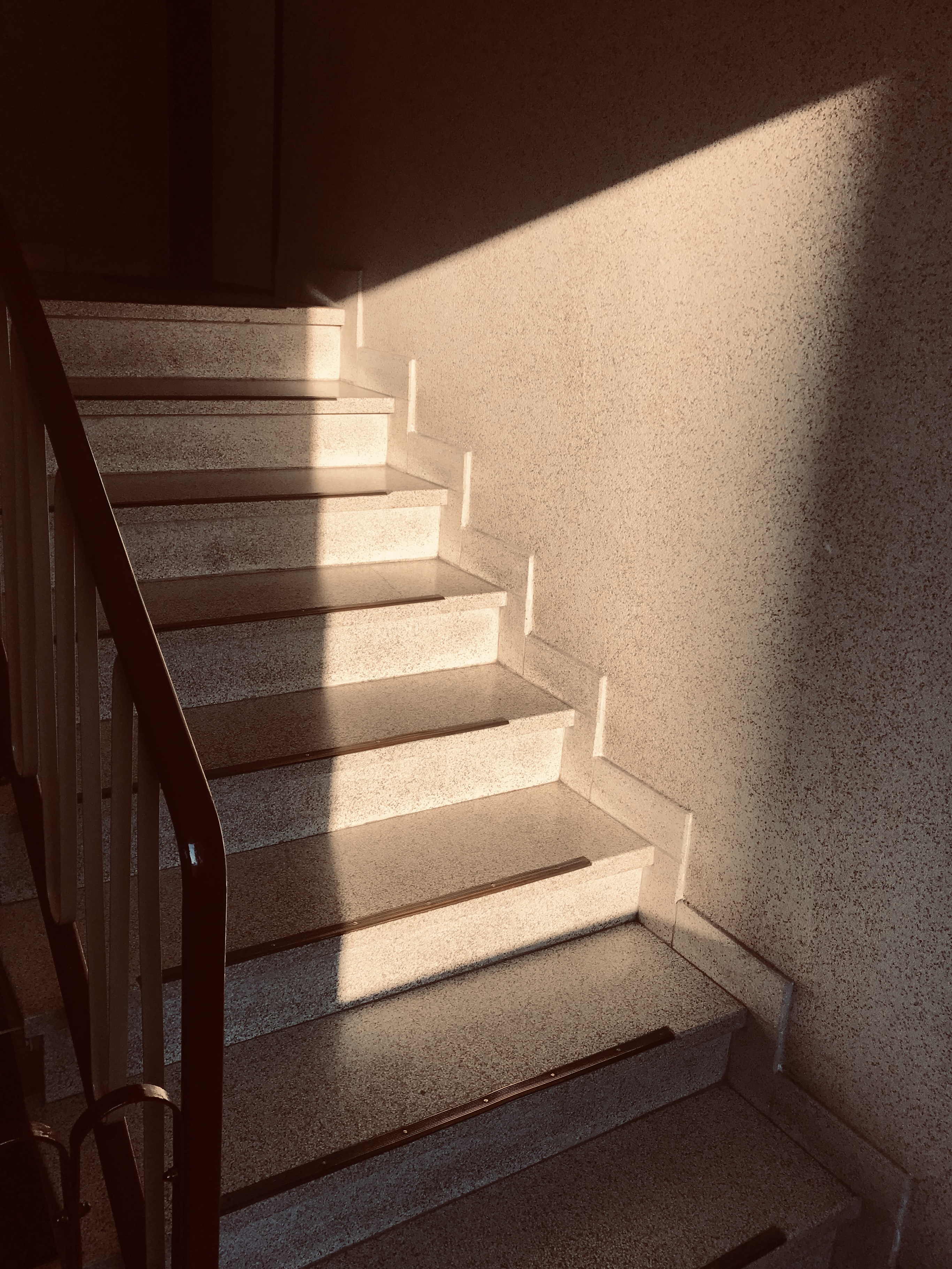
Life is a little bit like the stairs up to my apartment. 

I walk up two stairs and come to a big window, where I can see half the sun over the roof of the building next doors. Then I walk up a couple more stairs, and by the next window, the sun is shining golden in my face. I feel it in my back as I continue walking. But it’s darker on the next platform, always a little bit darker on the platforms by the doors until I turn around again and take the stairs up to the next window. And finally by my door, I open it and walk through the corridor. And suddenly I’m in the living room. And suddenly I can sit still for a bit in the sunshine. 

That’s what it’s like to deal with things. They get better, but then it gets a bit darker again. We see more light, but then we keep going upwards and it feels like we’re moving away from the sun. But we’re just moving higher, and as time goes on we’ll end up in a place where we can see it better than ever before.

IMG_0522

(But even then, being healed does not mean always seeing the sun. It just means dwelling in that high place and knowing that we all have our own ways of moving through light and darkness.)

Thoughts from yesterday

You learn more from the sky if you study it as a poet than as a scientist.

(That’s a sentence that just kind of “sound good”, but I mean it very seriously. I chose an extra astronomy class in school as if it would bring me deeper into the mystery of open space, but most of the lectures were spent memorizing complicated mathematical formulas that described the distance between stars, and I got answers in amount of light years, but it wasn’t really what I was searching for.

federico-beccari-L8126OwlroY-unsplash

I was thinking about it lately, because I was looking through the Narnia books and read this:

“In our world a star is just a big ball of flaming gas.”
“Even in your world, my son, that is not what a star is, but only what it is made of.”

And I was thinking that stars can feel so non-romantic when we’ve learned their chemichal/biological components. But on the other hand we know that people are mainly made out of simple H2O, and that doesn’t seem to take the magic out of us. We know that we’re more than what we’re made of. Maybe it’s the same with the things in nature that science seems to have taken the mystery out of.)

I guess because it’s what poetry does, it doesn’t try to erase the mystery, it tries to carry you deeper into it.

The ‘A Little Longer’

What if we all would stay
a little bit longer
before we leave our moments
before stepping into the next 

(Then maybe we would stop)
leaning awkwardly against our own ribs
instead sinking into the armchair
of every moment
that makes up our lives. 

Lately I’ve been trying to stay ‘a little longer’ in every moment, just before I do something new. And I’ve realised that it’s easier to wait an extra 60 seconds before you go on your phone than it is to decide that you won’t even look at instagram for a whole night. And it proves to you: your own self control – in case you want to not look at your phone the rest of the night. You cut off habit and make an actual choice.

You sit down in your bed, pick up your phone, and then you put it down again. Stare straight ahead. Think a little bit. Be with God, be with yourself. Maybe close your eyes. And then you can pick it up again. 

Let every moment linger. Think a bit. Realise something new, write something down. More starts growing in your mind. Such is the nature of the sitting down.

IMG_0414

On Tension

Life is lived in the tension, and tensions there are many; To take control over your own life, while simultaneously accepting the leadership and sovereignty of God. To in storytelling share and show, while simultaneously hide the necessary parts. Living out your identity while simultaneously seeking it.

I’m workin on moving the center of control into myself, instead of letting circumstances or surroundings design and decide me, but I need to flow like a river in this, sensitive to that small, great (once again: tension) voice telling me to change direction.

You can be strong and centered while still letting the whirlwind of contradictions exist inside of you. For maturity, it’s essential that you are.

Sunday thoughts (8)

I read somewhere recently: 

“Christ didn’t die for your dreams, he died for your sins.”

And it’s so true. Let’s precede this with saying that of course God has a calling for your life, and of course he has amazing things he wants to lead you into, and dreams he has put into your heart. But he did not die for you to finally be able to get on that airplane and live that lifestyle you’ve always wanted to. He did not die for you to finally have that new job opportunity, savings account or success. Christ died for your sins. He died for you to be a new creation, pure and blameless, whether you’re in a minimum wage job or have an office with a skyline view. The main thing he died to bring you into is himself. Away from damnation and into eternity. That’s what we have waiting for us, that’s the life we have, changed and free, at a fancy restaurant patio or out on the streets.